
How Artificial Grass Tennis Courts Are Constructed
How Artificial Grass Tennis Courts Are Constructed
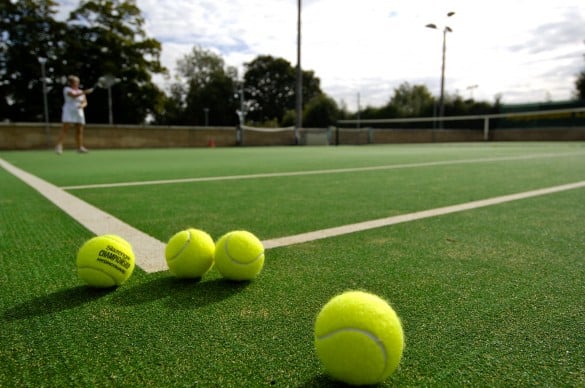
An artificial grass tennis court is built from the formation upward: earthworks, drainage, aggregate, porous asphalt or concrete, turf, seams, lines and sand infill. The carpet is installed near the end, but most failures begin below it. If the base moves, holds water or falls outside level tolerance, even an excellent tennis turf will play badly.
The sequence below is intended for project owners and contractors planning a new sand-filled synthetic grass court or evaluating a resurfacing proposal. Local engineering and sports-body requirements take precedence over any generic layer thickness.
What a typical court system contains
| Layer or component | Purpose | Typical quality risk |
|---|---|---|
| Prepared formation | Stable platform for the works above | Soft spots, uncontrolled fill or poor compaction |
| Drainage | Moves water away from and beneath the court | Undersized pipes, blocked outlets or no legal discharge point |
| Aggregate sub-base | Load distribution, stability and frost resistance where required | Wrong grading, segregation or inadequate depth |
| Porous asphalt or concrete base | Accurate, durable receiving surface | Low spots, cracks, contamination or abrupt falls |
| Artificial grass | Playing and wearing surface | Wrong pile direction, wrinkles, poor seams or unsuitable product |
| Sand infill | Supports fibres and tunes play | Wet or poorly graded sand and uneven distribution |
1. Turn the playing brief into a design
Start with the number of courts, player level, weekly use, indoor or outdoor condition and the governing requirements. Confirm the playing lines, run-off zones, orientation, accessibility, fencing, net-post system, lighting and spectator needs. A court built for a private residence does not have the same circulation, lighting or wear demands as a municipal club.
Decide early whether the project is a new build or resurfacing. For resurfacing, the existing surface must be surveyed for cracks, movement, levels, drainage and remaining structural life. Laying new turf over a defective base postpones the defect; it does not solve it.
2. Survey the site and investigate the ground
A topographic survey establishes finished levels, boundaries and drainage routes. Ground investigation should identify weak soil, uncontrolled fill, groundwater and frost risk where relevant. The civil engineer can then set the formation level and design any capping or stabilization.
Check construction access before excavation starts. Aggregate, asphalt plant and turf rolls need a practical route to the court. On a tight site, the cost of small-load deliveries and manual handling can be significant.
3. Coordinate buried work before the base
Install or allow for drainage, electrical ducts, lighting foundations, fence-post foundations and net-post sockets before the finished pavement is placed. Mark and record their positions. Cutting a newly laid porous base for a forgotten cable route is an avoidable source of cracks and settlement.
The drainage design should use local rainfall data and a confirmed outlet. Perimeter drains, collector pipes, channels and a permeable pavement may all be involved. The visible turf can drain quickly while the court below remains saturated if the outlet or sub-base is inadequate.
4. Excavate and prepare the formation
Remove topsoil and unsuitable material to the designed depth. Shape and compact the formation, then inspect it before covering. Soft areas should be treated according to the engineer’s design rather than hidden with extra stone. A geotextile separator may be specified to prevent fine soil migrating into the aggregate.
At this stage, verify the overall court dimensions and finished-height relationship to paths, thresholds and drainage channels. Errors become harder to correct with every layer added.
5. Place and compact the sub-base
The aggregate is normally placed in controlled layers and compacted to the specified density and levels. Material should be well graded, clean and appropriate for drainage and frost conditions. The contractor records layer thicknesses, levels and test results at agreed hold points.
The ITF court construction guide illustrates one porous artificial-grass build-up with a minimum 150 mm compacted, non-frost-susceptible crushed-stone foundation, followed by approximately 40 mm porous asphalt base course and 25 mm open-grade porous asphalt. Treat those figures as guidance, not a universal design; soil, climate and local materials may justify another construction.
6. Install edging, sockets and fencing foundations
Perimeter edging defines the pavement and protects turf edges. Net-post sockets need accurate line, level and spacing, with foundations that resist the net load without moving. Fence foundations and gates should be coordinated with maintenance access and player safety.
Do not tension the net against temporary or under-sized foundations. Small alignment errors at socket stage are very visible on the completed court.
7. Lay the asphalt or concrete base
Porous asphalt is commonly placed in two courses to provide both strength and a smooth open-textured finish. Concrete may be used in other designs. Whichever base is selected, the priorities are structural stability, accurate levels, appropriate falls and a clean finish compatible with the adhesive and drainage strategy.
Inspect the base with a level survey and straightedge. Correct birdbaths, ridges, open joints, contamination and damaged edges before turf delivery. Allow the base to cure and dry as required by the designer, asphalt supplier and adhesive manufacturer.
8. Plan the roll layout before cutting
Prepare a drawing showing roll direction, seam positions, line inserts and offcuts. All main rolls should run with a consistent pile direction. Keep unnecessary seams away from heavily used areas where possible and confirm that roll widths match the court geometry.
On delivery, check product codes, roll numbers, dimensions and visible condition against the packing list. Store rolls on a firm, clean surface and protect them from deformation and contamination.
9. Lay and seam the tennis turf
Sweep the substrate thoroughly. Position the rolls, allow them to relax if recommended, and trim the edges without cutting tufts. Adjacent rolls are joined with the specified seaming tape and adhesive. The bond line must be continuous and clean; excess adhesive can harden the pile and affect ball bounce.
Playing lines may be tufted during manufacture or cut into the surface on site. Site-cut lines require accurate setting-out and secure bonding. Check every intersection and line width before the adhesive cures.
10. Install the sand infill in dry, measured passes
Use the sand grading and dosage specified for the exact turf. The sand and carpet should be dry enough for even application. Spread the infill in several light passes and brush between them so it settles into the pile rather than forming ridges on top.
Record the quantity used by court. Final sand level influences fibre support, traction and ball pace. A court that merely “looks full” may still have large local differences.
11. Commission the complete court
Install the net, gates, windscreens and remaining equipment, then inspect the completed facility. The handover should cover:
- court and line dimensions;
- surface regularity and drainage;
- seam and line adhesion;
- infill depth and uniformity;
- net-post alignment and net height;
- fence, gate and lighting safety;
- as-built drawings, product records and maintenance instructions.
If the contract requires performance testing, agree the test method and acceptance limits before construction. A final inspection cannot resolve an ambiguous specification.
New build and resurfacing are not the same job
A resurfacing quote may look attractive because earthworks and drainage are excluded. That is reasonable only when the existing pavement is structurally sound and accurately graded. Ask the contractor to identify which cracks will be repaired, how old adhesive and infill will be removed, and who accepts the risk of reflective cracking or retained low spots.
What to include in the RFQ
Send dimensioned drawings, site location, climate, ground or existing-base information, court use, governing requirement, desired playing characteristics, drainage responsibility, turf and infill scope, line colours, installation location, access restrictions and programme. Request a roll layout, product data, applicable reports, installation method, exclusions and maintenance plan.
Tiger Lily Garden publishes a 15 mm fibrillated tennis product and shows yarn production, tufting, coating, inspection and packing in its factory workflow. Buyers can compare the sports artificial grass range and relevant installation accessories. For a project-specific recommendation, send the court drawing, base type and target playing level.
